通化摩托车英文题库
1. The sign on the right warns of a sharp winding road ahead.

A. Right
B. Wrong
Answer: B
2. As shown in the flash, what should the driver do when the motor vehicle encounters this situation?

A. Speed up and pass rapidly
B. Stop immediately
C. Sound the horn to indicate the pedestrians to yield
D. Observe the movement of pedestrians and non-motor vehicles before passing
Answer: D
3. Motor vehicles should accelerate when driving into an intersection with this traffic signal.

A. Right
B. Wrong
Answer: B
4. Under the circumstances shown in the flash, what should be done by the vehicle in front?

A. Reduce speed swiftly or apply emergency brake
B. Drive at a higher speed after giving a proper space
C. Reduce speed and yield by the right side of the road
D. Drive at a higher speed by the right side of the road
Answer: C
5. When driving in thick fog causing poor visibility on the expressway, the driver should apply emergency braking to stop at once.
A. Right
B. Wrong
Answer: B
6. The broken yellow line in the center of the road indicates that bypassing by crossing the line is prohibited in any condition.

A. Right
B. Wrong
Answer: B
7. If a motor vehicle misses an exit on the expressway, the driver may reverse along the road shoulder.
A. Right
B. Wrong
Answer: B
8. Drivers may cross these central solid and broken yellow lines when overtaking.

A. Right
B. Wrong
Answer: B
9. It is safest for a motor vehicle driver to overtake the vehicle in front from its righthand on this kind of road.

A. Right
B. Wrong
Answer: B
10. The sign on the left indicates U-turn is allowed here.

A. Right
B. Wrong
Answer: A
11. When a motor vehicle skids sideways on a muddy road, the driver should turn the steering wheel in the direction of the rear wheel skidding to properly adjust the direction.
A. Right
B. Wrong
Answer: A
12. Under this circumstance, motor vehicle drivers should give the right of way to oncoming vehicle.

A. Right
B. Wrong
Answer: A
13. When seeing this sign, the driver should slow down promptly.

A. Right
B. Wrong
Answer: A
14. When driving on an expressway, what should the driver do if he has missed an exit but the next exit is far away?
A. Reverse along the road shoulder
B. Continue on
C. Stop immediately
D. Make a U-turn at the current location
Answer: B
15. The sign in front indicates a 2-kilometer distance from the destination of the highway ahead.

A. Right
B. Wrong
Answer: A
16. When such circumstances happen suddenly, what should the driver do?

A. Reduce speed or stop to yield
B. Bypass in front of the pedestrians
C. Continuously sound the horn to alert the pedestrians
D. Bypass from behind the pedestrians
Answer: A
17. At 13: 10 pm, Mr. Luo set out in his medium bus from 0 km mark on the highway, and by 14: 10 had passed the 125km mark by 200 meters, he caused a rear-end collision with a motor vehicle that ran into the side slope on the southwest side, killing 11 people and injuring 2. Which of the following law-breaking acts did Mr. Luo commit?
A. Speeding
B. Driving not in accordance with traffic markings
C. Exceeding carrying capacity
D. Fatigued driving
Answer: A
18. Which one of the following is a safe way for motor vehicles to converge into an intersection marked with this sign?

A. Speeding up and driving into the traffic flow directly
B. Driving into the traffic flow behind the gray car on the main road
C. Driving into the traffic flow from the front of the red car on the main road
D. Turning on the indicator and driving into the flow directly
Answer: B
19. The sign on the right indicates a left-turn bypass route at the intersection ahead.

A. Right
B. Wrong
Answer: A
20. Under such circumstances, what should motor vehicle drivers do?

A. Follow the vehicle closely
B. Overtake the vehicle quickly on its left
C. Keep a long braking distance
D. Overtake the vehicle quickly on its right
Answer: C
21. When encountering such a situation, motor vehicle drivers should take the left lane.

A. Right
B. Wrong
Answer: B
22. When a motor vehicle turns left at this intersection the driver should change to the left lane in advance by the guide arrow.

A. Right
B. Wrong
Answer: A
23. The sign on the right warns of an uneven road ahead.
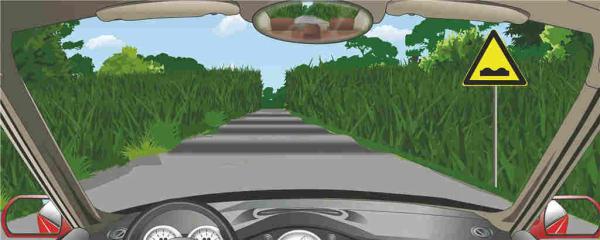
A. Right
B. Wrong
Answer: A
24. When driving on a muddy road, the driver should hold the steering wheel firmly and speed up to pass through.
A. Right
B. Wrong
Answer: B
25. Motor vehicle drivers don’t need to use any lamp at night when passing through a road section where the street light condition is good.
A. Right
B. Wrong
Answer: B
- 有国外驾照的外国人只需考科目一
-
- ENGLISH 英语科目一2026年新题库 驾照:C1 C2
- FRENCH 法语科目一2026年新题库 驾照:C1 C2
- GERMAN 德语科目一2026年新题库 驾照:C1 C2
- SPANISH 西班牙语科目一2026年新题库 驾照:C1 C2
- JAPANESE 日语科目一2026年新题库 驾照:C1 C2
- KOREAN 韩语科目一2026年新题库 驾照:C1 C2
- RUSSIAN 俄语科目一2026年新题库 驾照:C1 C2
- ARABIC 阿拉伯语科目一2026年新题库 驾照:C1 C2
- MOTORCYCLE 摩托车科目一2026年新题库 驾照:D E
- 没有国外驾照的外国人还需要考科目四
-
- ENGLISH 英语科目四2026年新题库 驾照:C1 C2
- KOREAN 韩语科目四2026年新题库 驾照:C1 C2
- MOTORCYCLE 摩托车科目四2026年新题库 驾照:D E