金华摩托车科目一考试英文400题
1. When passing an intersection, vehicle motor drivers are not allowed to overtake.
A. Right
B. Wrong
Answer: A
2. The sign in front gives information about the direction of road exits.

A. Right
B. Wrong
Answer: A
3. Gun powder, explosives and detonating powder belong to which of the following dangerous chemicals?
A. Oxidizing materials
B. Inflammable solid materials
C. Explosives
D. Self-igniting articles
Answer: C
4. The sign on the right warns of a one-way tunnel ahead.

A. Right
B. Wrong
Answer: B
5. The sign in front indicates a one-way lane after turning left.

A. Right
B. Wrong
Answer: A
6. As shown in this picture, the intersection guide line is designed to help drivers make turns.

A. Right
B. Wrong
Answer: A
7. When the driver discovers a tire is leaking and steers the vehicle off the main driving lane, he/she should refrain from applying emergency braking so as to avoid a vehicle turnover or a rear-end collision arising from the late braking of the vehicle behind.
A. Right
B. Wrong
Answer: A
8. The leading cause of this accident is that the driver failed to make sure that it was safe to reverse before doing so.

A. Right
B. Wrong
Answer: A
9. When a motor vehicle enters an expressway from the ramp, which of the following lamps should be turned on?
A. The left-turn indicator
B. The right-turn indicator
C. The hazard warning lamp
D. The headlamp
Answer: A
10. When driving on a muddy road, what should drivers do to pass at an even speed without stopping?
A. Use the handbrake
B. Press the clutch pedal
C. Press the brake pedal
D. Use the accelerator pedal
Answer: D
11. The sign on the left indicates the destinations of two highway directions

A. Right
B. Wrong
Answer: A
12. When driving, besides paying attention to keeping a safe distance from the vehicle in front, drivers should also be prudent when braking so as to avoid a rear-end collision caused by a vehicle behind.
A. Right
B. Wrong
Answer: A
13. The sign on the right warns of a hump bridge right ahead.

A. Right
B. Wrong
Answer: B
14. Matches, sulfur and red phosphorus belong to which of the following dangerous chemicals?
A. Explosives
B. Oxidizing materials
C. Self-igniting articles
D. Inflammable solid materials
Answer: D
15. When a wounded person is unable to get off the vehicle by himself, he should be removed from the vehicle so as to avoid a secondary injury.
A. Right
B. Wrong
Answer: A
16. Crossing the broken white line on the right edge of the road is allowed.

A. Right
B. Wrong
Answer: A
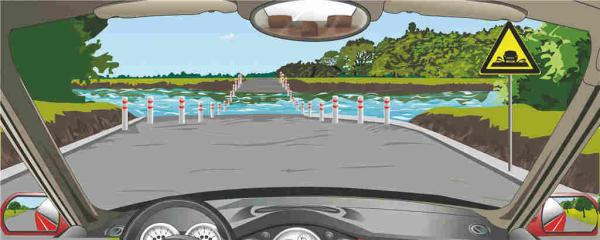
17. The sign on the right warns of a wet road surface ahead.
A. Right
B. Wrong
Answer: A
18. It is safest for a motor vehicle driver to overtake the vehicle in front from its righthand on this kind of road.

A. Right
B. Wrong
Answer: B
19. What should the driver do in this situation?

A. Speed up and overtake from the left side
B. Sound the horn continuously to warn the bicycle
C. Follow the bicycle closely
D. Slow down and yield to the bicycle
Answer: D
20. When approaching the turning point of a road, in which of the following ways will motor vehicle drivers easily cause a traffic accident?
A. Driving ahead by occupying the opposite lane
B. Turning the steering wheel quickly when passing through the curve
C. Not reducing speed until driving onto the curve
D. Driving by the right side
Answer: ABC
21. This sign warns of an intersection of railways and highways ahead.

A. Right
B. Wrong
Answer: A
22. Before making a U-turn at the intersection ahead, motor vehicle drivers should drive to the lane for turning left and going straight.

A. Right
B. Wrong
Answer: B
23. For a temporary stop on a foggy day, the driver should only turn on the fog lamp and the low-beam
A. Right
B. Wrong
Answer: B
24. Mr. Peng drove a heavy semi-trailer tractor with 37.7 tons of cargo (capacity 25 tons). When descending a slope on the Daguang Expressway, the tractor had a rear-end collision with Mr. Li’s heavy dump truck (carrying 3.17 cubes of loess and 24 passengers in the container) occupying the emergency lane. As a result of this accident, 16 people were killed and 13 injured. What are the main illegal acts in this case?
A. Mr Peng exceeded the speed limit
B. Mr. Peng’s tractor carried more cargo than limited
C. Mr Li illegally drove in the emergency lane
D. Mr. Li’s truck illegally carried passengers in the container
Answer: BCD
25. When parking temporarily in this situation, motor vehicle drivers are allowed to turn the steering wheel right to avoid sliding.

A. Right
B. Wrong
Answer: A
- 有国外驾照的外国人只需考科目一
-
- ENGLISH 英语科目一2026年新题库 驾照:C1 C2
- FRENCH 法语科目一2026年新题库 驾照:C1 C2
- GERMAN 德语科目一2026年新题库 驾照:C1 C2
- SPANISH 西班牙语科目一2026年新题库 驾照:C1 C2
- JAPANESE 日语科目一2026年新题库 驾照:C1 C2
- KOREAN 韩语科目一2026年新题库 驾照:C1 C2
- RUSSIAN 俄语科目一2026年新题库 驾照:C1 C2
- ARABIC 阿拉伯语科目一2026年新题库 驾照:C1 C2
- MOTORCYCLE 摩托车科目一2026年新题库 驾照:D E
- 没有国外驾照的外国人还需要考科目四
-
- ENGLISH 英语科目四2026年新题库 驾照:C1 C2
- KOREAN 韩语科目四2026年新题库 驾照:C1 C2
- MOTORCYCLE 摩托车科目四2026年新题库 驾照:D E