伊春2026英文驾考科目四
1. If a motor vehicle encounters a strong side wind when it leaves the opening of an expressway tunnel, what will happen?
A. A feeling of deceleration
B. A feeling of acceleration
C. A feeling of pressure
D. Deviation in direction
Answer: D
2. What should be done by the driver who intends to overtake but finds that the vehicle in front is also overtaking?
A. Following the vehicle in front closely and finding a chance to overtake it
B. Accelerating to overtake forcefully
C. Continuously sounding the horn to urge the vehicle in front to yield
D. Refraining from overtaking and letting the vehicle in front overtake first
Answer: D
3. When a motor vehicle encounters an accident on an expressway, the driver and all passengers should not get off the vehicle and walk around at will.
A. Right
B. Wrong
Answer: B
4. During normal driving, the driver should do his best to run close to or on the central line so as not to allow oncoming vehicles any opportunity to occupy his own route.
A. Right
B. Wrong
Answer: B
5. Under such circumstances at a congested intersection, what should motor vehicle drivers do?

A. Force the vehicle to go back to its original lane
B. Closely follow the vehicle in front and refuse to yield
C. Politely yield and pass through
D. Sound the horn and turn on the head lamps
Answer: C
6. Mr. Zou drove a large sleeper coach (capacity 35 people and carrying 47 passengers). At the spot of 938 kilometers of the Jinggang ao Expressway, large amounts of dangerous chemicals in the coach blew up, killing 41 people and injuring 6. What are the main illegal acts in this case?
A. Carrying more passengers than permitted
B. Passengers carried flammable and explosive substances
C. Speeding
D. Illegal parking
Answer: AB
7. The guide arrow on the road surface of this lane indicates that drivers are only permitted to continue straight at the intersection ahead.

A. Right
B. Wrong
Answer: B
8. When the engine suddenly stalls on the road and cannot be restarted, the driver should pull over in a timely fashion and identify the cause of the stalling.
A. Right
B. Wrong
Answer: A
9. Which one of the following is the safest way when driving a motor vehicle on this kind of road surface?
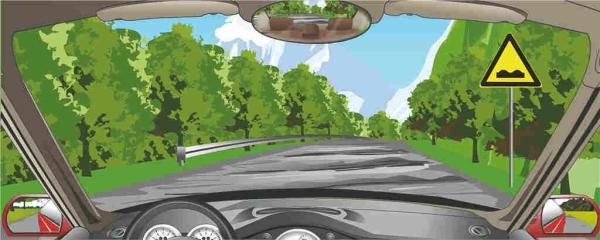
A. Slide over by using neutral gear
B. Pass with a high speed
C. Pass by speeding up
D. Pass with a low speed
Answer: D
10. As shown in this picture, the vehicles intending to turn left are allowed to drive into the left-turn waiting area directly to wait for the green light.

A. Right
B. Wrong
Answer: B
11. The sign in the red circle indicates that the left road is only for small vehicles.

A. Right
B. Wrong
Answer: B
12. The sign on the right warns of an unguarded railway crossing 150 meters ahead.

A. Right
B. Wrong
Answer: A
13. When the tire pressure is too low, what can happen when driving at a high speed?
A. Tire pressure will be unstable
B. Tire pressure will increase
C. Driving resistance will decrease
D. The tire will burst
Answer: D
14. Under such circumstances, what should be done by the motor vehicle driver?

A. Reducing speed to give the right of way to the non-motor vehicle
B. Continuously sounding the horn to warn the vehicle in front to yield
C. Bypassing on the left of the non-motor vehicle
D. Accelerating to overtake by occupying the opposite lane
Answer: A
15. The sign on the right indicates that the number of the lanes ahead will increase.

A. Right
B. Wrong
Answer: B
16. The broken yellow line in the center of the road indicates that bypassing by crossing the line is prohibited in any condition.

A. Right
B. Wrong
Answer: B
17. Turning on the high-beam is an effective way to improve visibility in fog weather.
A. Right
B. Wrong
Answer: B
18. The sign on the right warns of a danger from rockfall on the left side.

A. Right
B. Wrong
Answer: A
19. As shown in this flash, what should the motor vehicle driver do when encounters this situation?

A. Use the mergency brake
B. Turn sharply and pass rapidly
C. Slide over rapidly without encountering collision
D. Stop smoothly
Answer: D
20. Which one of the following statements is the safest measure for a motor vehicle driver to take on this kind of road?

A. Accelerate to overtake the vehicle in front as soon as possible
B. Sound the horn to warn the vehicle in front to yield
C. Follow the vehicle in front and keep a certain distance
D. Overtake the vehicle in front from its righthand
Answer: C
21. Where is the proper parking place for motor vehicles driving on an expressway?
A. On the expressway ramp
B. In the acceleration lane
C. In the deceleration lane
D. In a service area
Answer: D
22. Which of the following measures is incorrect when a motor vehicle stops?
A. Stop at a stipulated place
B. Avoid stopping on pedestrian streets
C. Avoid obstructing the passing of other motor vehicles and pedestrians when temporarily stops on the road
D. Stop on the non-motor vehicle lane
Answer: D
23. Under such circumstances, motor vehicles are not allowed to overtake.

A. Right
B. Wrong
Answer: A
24. The road marking on the right lane indicates that drivers may temporarily borrow the special lane for buses.

A. Right
B. Wrong
Answer: B
25. As shown in this picture, the intersection guide line is designed to help drivers make turns.

A. Right
B. Wrong
Answer: A
- 有国外驾照的外国人只需考科目一
-
- ENGLISH 英语科目一2026年新题库 驾照:C1 C2
- FRENCH 法语科目一2026年新题库 驾照:C1 C2
- GERMAN 德语科目一2026年新题库 驾照:C1 C2
- SPANISH 西班牙语科目一2026年新题库 驾照:C1 C2
- JAPANESE 日语科目一2026年新题库 驾照:C1 C2
- KOREAN 韩语科目一2026年新题库 驾照:C1 C2
- RUSSIAN 俄语科目一2026年新题库 驾照:C1 C2
- ARABIC 阿拉伯语科目一2026年新题库 驾照:C1 C2
- MOTORCYCLE 摩托车科目一2026年新题库 驾照:D E
- 没有国外驾照的外国人还需要考科目四
-
- ENGLISH 英语科目四2026年新题库 驾照:C1 C2
- KOREAN 韩语科目四2026年新题库 驾照:C1 C2
- MOTORCYCLE 摩托车科目四2026年新题库 驾照:D E