遵义科目四英文试题
1. The sign in front indicates an open-air parking lot with rest area is 200 meters ahead.

A. Right
B. Wrong
Answer: A
2. Where is the proper parking place for motor vehicles driving on an expressway?
A. On the expressway ramp
B. In the acceleration lane
C. In the deceleration lane
D. In a service area
Answer: D
3. When the vehicle engine catches fire, what should the driver do first?
A. Turn off the engine as soon as possible
B. Extinguish the fire with water
C. Open the hood to extinguish the fire
D. Extinguish the fire from the leeward direction
Answer: A
4. When a motor vehicle encounters an emergency on an expressway, the driver should not swiftly turn the steering wheel to evade.
A. Right
B. Wrong
Answer: A
5. After a traffic accident, what is the most effective measure to prevent secondary accidents?
A. Evacuate all passengers
B. Turn on the hazard lamps
C. Mark the original place of the injured persons
D. Properly place the danger warning sign
Answer: ABD
6. When a motor vehicle enters an expressway from the ramp, which of the following lamps should be turned on?
A. The left-turn indicator
B. The right-turn indicator
C. The hazard warning lamp
D. The headlamp
Answer: A
7. What should the driver do when the motor vehicle encounters this situation in front of a school?
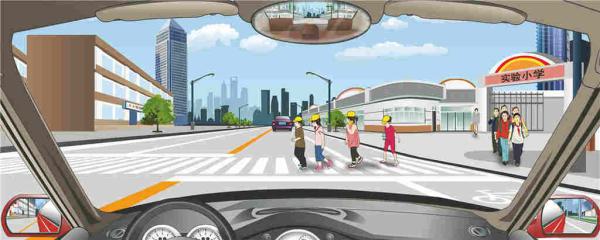
A. Bypass before the queue
B. Slow down and pass slowly
C. Stop promptly and yield
D. Go through in the spaces between the queues
Answer: C
8. As shown in this picture, the vehicles intending to turn left are allowed to drive into the left-turn waiting area directly to wait for the green light.

A. Right
B. Wrong
Answer: B
9. The sign on the right warns of low-lying road ahead.

A. Right
B. Wrong
Answer: A
10. When parking for a long time on a downward slope due to breakdown on the road, drivers should use this method to stop up wheels.

A. Right
B. Wrong
Answer: A
11. What influence does smoking have upon driving?
A. Harmful for safe driving
B. Increase concentration
C. Help relaxation
D. No effect on driving
Answer: A
12. When encountering such a situation, motor vehicle drivers should take the left lane.

A. Right
B. Wrong
Answer: B
13. What should the driver do if he wants to turn left at this intersection?

A. Turn left along the straight-going lane
B. Enter the left turn waiting area
C. Enter the straight-moving waiting area
D. Turn left along the left lane
Answer: B
14. When following a vehicle on the road, the distance from the vehicle in front is not important. As long as the driver goes forward at the same speed as the vehicle in front does, he can avoid a rear-end collision.
A. Right
B. Wrong
Answer: B
15. The sign on the right indicates that the vehicle should yield to the oncoming traffic as approaching each other.

A. Right
B. Wrong
Answer: B
16. When a motor vehicle encounters this situation at a crosswalk, the driver must slow down and pass slowly.

A. Right
B. Wrong
Answer: B
17. When this signal is constantly flashing, how should a driver react?

A. Speed up as soon as possible
B. Pull over and wait
C. Observe the traffic situation around to make sure of safe driving
D. Refrain from passing
Answer: C
18. Mr. Tang drove a large bus with 74 passengers (capacity 30 people). When descending a long curving slope at a speed of 38 kilometers per hour, the bus overturned to a brook beside the road. As a result of the accident, 17 people were killed and 57 people injured. What is the main illegal act committed by Mr. Tang?
A. Driving after drinking
B. Carrying more passengers than permitted
C. Fatigued driving
D. Speeding
Answer: BD
19. The leading cause of this accident is that the driver failed to make sure that it was safe to reverse before doing so.

A. Right
B. Wrong
Answer: A
20. The sign on the right warns of three or more winding roads ahead.

A. Right
B. Wrong
Answer: B
21. The sign on the right warns of entering a tunnel, and requires reduced speed.

A. Right
B. Wrong
Answer: B
22. The circle in the center of the intersection indicates that drivers should drive along the inner side when making a small left turn.

A. Right
B. Wrong
Answer: A
23. What should drivers keep in mind when driving on a mountainous road?
A. Keep a safe distance
B. Avoid occupancy of another lane when making a turn
C. Downshift in advance when ascending an abrupt slope
D. Taking full advantage of engine braking when descending a long slope
Answer: ABCD
24. Sounding the horn on a foggy day can arouse the attention of the opposite side. After hearing the horn from the opposite side, the driver should also sound their own horn to respond.
A. Right
B. Wrong
Answer: A
25. The sign in front indicates a one-way lane after turning right.

A. Right
B. Wrong
Answer: A
- 有国外驾照的外国人只需考科目一
-
- ENGLISH 英语科目一2026年新题库 驾照:C1 C2
- FRENCH 法语科目一2026年新题库 驾照:C1 C2
- GERMAN 德语科目一2026年新题库 驾照:C1 C2
- SPANISH 西班牙语科目一2026年新题库 驾照:C1 C2
- JAPANESE 日语科目一2026年新题库 驾照:C1 C2
- KOREAN 韩语科目一2026年新题库 驾照:C1 C2
- RUSSIAN 俄语科目一2026年新题库 驾照:C1 C2
- ARABIC 阿拉伯语科目一2026年新题库 驾照:C1 C2
- MOTORCYCLE 摩托车科目一2026年新题库 驾照:D E
- 没有国外驾照的外国人还需要考科目四
-
- ENGLISH 英语科目四2026年新题库 驾照:C1 C2
- KOREAN 韩语科目四2026年新题库 驾照:C1 C2
- MOTORCYCLE 摩托车科目四2026年新题库 驾照:D E