株洲英文驾考科目四
1. Drivers may temporarily cross these central broken and solid yellow lines when overtaking.

A. Right
B. Wrong
Answer: A
2. This road marker indicates that the minimum speed for this road section is 60 km/hour.

A. Right
B. Wrong
Answer: B
3. When fixing the unexposed bones in position, it is necessary to exceed the upper and lower joints of the wounded body part.
A. Right
B. Wrong
Answer: A
4. Drivers may temporarily cross these central solid double yellow lines when overtaking.

A. Right
B. Wrong
Answer: B
5. The motor vehicle should slow down and pass slowly in this situation.

A. Right
B. Wrong
Answer: A
6. When such circumstances happen suddenly, what should the driver do?

A. Reduce speed or stop to yield
B. Bypass in front of the pedestrians
C. Continuously sound the horn to alert the pedestrians
D. Bypass from behind the pedestrians
Answer: A
7. When a wounded person is unable to get off the vehicle by himself, he should be removed from the vehicle so as to avoid a secondary injury.
A. Right
B. Wrong
Answer: A
8. After a traffic accident, what is the most effective measure to prevent secondary accidents?
A. Evacuate all passengers
B. Turn on the hazard lamps
C. Mark the original place of the injured persons
D. Properly place the danger warning sign
Answer: ABD
9. After entering the acceleration lane of an expressway, the driver should increase the speed to how many kilometers per hour?
A. More than 30 km/hour
B. More than 40 km/hour
C. More than 50 km/hour
D. More than 60 km/hour
Answer: D
10. In order to keep safe when driving on the highway, which ones of the following statements are prohibited acts?
A. Reversing, moving against regulations, making a U-turn by crossing the central divider, or stopping in the lane.
B. Riding or rolling on the lane-dividing line or driving on the shoulder
C. Overtaking on ramps, accelerations lanes, or deceleration lanes.
D. Testing vehicles or learning to drive a vehicle
Answer: ABCD
11. Which of the following measures should be taken first when rescuing a wounded person suffering blood loss?
A. Observe
B. Dress the wounds
C. Stop bleeding
D. Inquire
Answer: C
12. When encountering an obstacle on one side of the road, what should vehicles do as they approach each other?
A. The vehicle not encountering an obstacle should Yield to the other vehicle
B. The slower vehicle should yield to the faster
C. The vehicle encountering an obstacle should yield to the other vehicle
D. The faster vehicle should yield to the slower
Answer: C
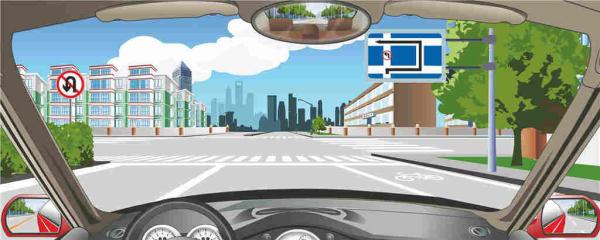
13. The sign on the right indicates a bypass route at the intersection ahead.
A. Right
B. Wrong
Answer: A
14. The red car is allowed to drive on this lane.

A. Right
B. Wrong
Answer: B
15. As shown in this picture, the vehicles intending to turn left are not allowed to drive into left-turn waiting area directly to wait for green light.

A. Right
B. Wrong
Answer: B
16. When carrying a wounded person in a coma, rescue personnel should try to let the unconscious person remain in the supine position.
A. Right
B. Wrong
Answer: B
17. When evading an emergency, except for being calm, what principle should be held by drivers?
A. Evading people first and then objects
B. Evading objects first and then vehicles
C. Evading vehicles first and then people
D. Evading objects first and then people
Answer: A
18. How should lamps be used by the motor vehicle driver who follows a vehicle on a road section where the street light condition is good?
A. Turn off the headlamp
B. Use high-beam
C. Turn off all lamps
D. Use low-beam
Answer: D
19. When a motor vehicle encounters thick fog on an expressway and the visibility is poor, the driver should immediately brake and stop.
A. Right
B. Wrong
Answer: B
20. What should the driver do if he wants to turn right at this intersection?

A. Turn right along the straight-going lane
B. Wait behind the stop line
C. Turn right along the right lane
D. Borrow the non-motor vehicle lane and turn right
Answer: C
21. When driving on a muddy road, what should drivers do if the wheels spin and slide?
A. Cover the ground under the wheels with gravels
B. Change to a high gear and speed out
C. Cover the ground under the driving wheels with gravels
D. Violently turn the steering wheel and suddenly speed up
Answer: C
22. Matches, sulfur and red phosphorus belong to which of the following dangerous chemicals?
A. Explosives
B. Oxidizing materials
C. Self-igniting articles
D. Inflammable solid materials
Answer: D
23. The guide arrow on the road surface of this lane indicates that only right turns are permitted at the intersection ahead.

A. Right
B. Wrong
Answer: B
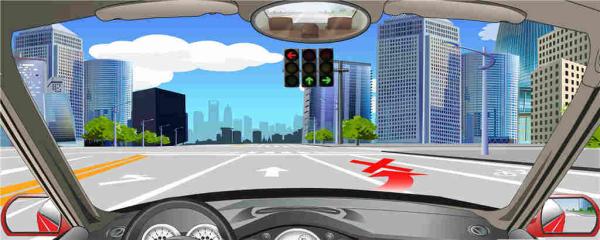
24. As shown in this picture, before driving to the intersection, vehicles are not allowed to change lanes by crossing the solid white line.
A. Right
B. Wrong
Answer: A
25. When driving on an expressway, which of the following statements is correct?
A. Drivers may overtake on either the ramp, the acceleration lane or the deceleration lane
B. Drivers are prohibited from reversing, driving in the opposite direction or making a U turn by crossing the central dividing strip
C. Drivers may drive on the emergency lane in a non-emergency case
D. Drivers may test a motor vehicle or learn to drive
Answer: B
- 有国外驾照的外国人只需考科目一
-
- ENGLISH 英语科目一2027年新题库 驾照:C1 C2
- FRENCH 法语科目一2027年新题库 驾照:C1 C2
- GERMAN 德语科目一2027年新题库 驾照:C1 C2
- SPANISH 西班牙语科目一2027年新题库 驾照:C1 C2
- JAPANESE 日语科目一2027年新题库 驾照:C1 C2
- KOREAN 韩语科目一2027年新题库 驾照:C1 C2
- RUSSIAN 俄语科目一2027年新题库 驾照:C1 C2
- ARABIC 阿拉伯语科目一2027年新题库 驾照:C1 C2
- MOTORCYCLE 摩托车科目一2027年新题库 驾照:D E
- 没有国外驾照的外国人还需要考科目四
-
- ENGLISH 英语科目四2027年新题库 驾照:C1 C2
- KOREAN 韩语科目四2027年新题库 驾照:C1 C2
- MOTORCYCLE 摩托车科目四2027年新题库 驾照:D E